


Welcome! We are the Parallel Programming Laboratory.
Our goal is to develop technology that improves performance of parallel applications while also improving programmer productivity. We aim to reach a point where, with our freely distributed software base, complex irregular and dynamic applications can (a) be developed quickly and (b) perform scalably on machines with thousands of processors.
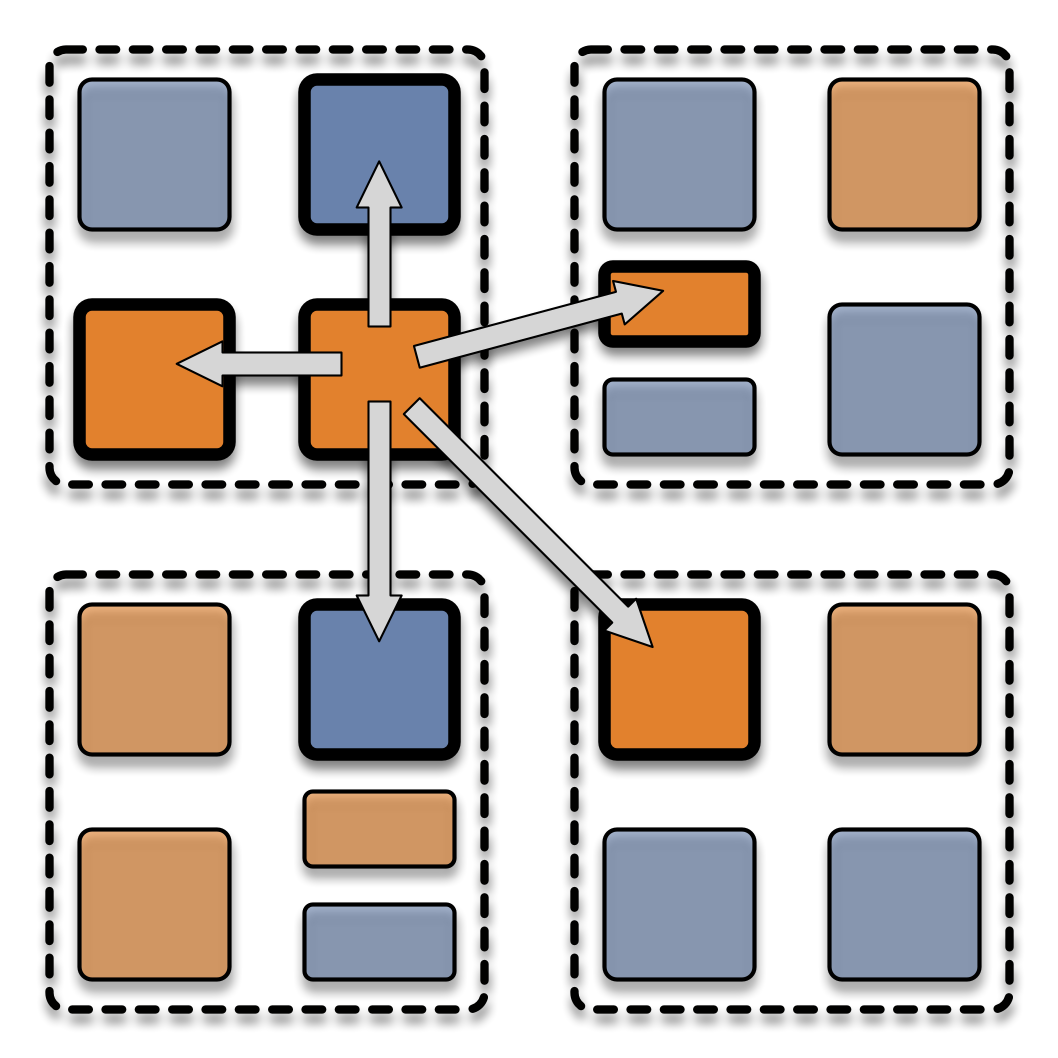
Processor virtualization is one of our core techniques: the programmer divides the computation into a large number of entities, which are mapped to the available processors by an intelligent runtime system. This separation of concerns between programmers and the system is key to attaining both our goals together.
Charm++ 8.0.0
Charm++ Version 8.0.0 Release
- The License has changed to Apache 2.0 with LLVM exception. This
change to a popular Open Source license is intended to simplify use,
collaboration, and greater community involvement in the development
of Charm++. The NOTICE file contains the pertinent disclaimers.
- The CkIO library (previously only supporting file output) has been
enhanced to support file input. The input layer enables two-phase,
collective input from a single file via an array of...